What Is End-Matched Tongue-and-Groove Paneling?
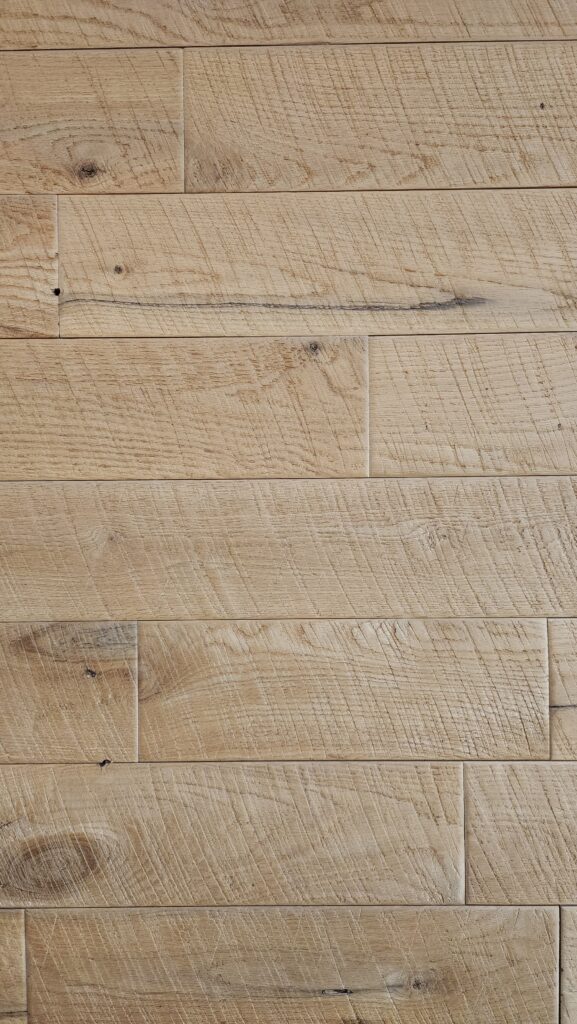
Tongue-and-groove paneling normally interlocks along the sides of each board. End matching adds a corresponding tongue-and-groove profile to the board ends, allowing adjoining pieces to lock together instead of meeting at a square butt joint.
For most hardwood paneling installations with end seams, that small manufacturing step provides several practical benefits.
Easier Layout and Installation
Square-ended paneling generally needs to be measured and cut so every end joint lands on a stud, ceiling joist, or strapping. End-matched boards can join between framing members because the machined profile holds the neighboring ends together. This gives the installer more freedom to use each board where it fits best.
End matching does not replace proper fastening. H&H Lumber recommends using a pneumatic nail gun to place small fasteners through the tongue wherever the paneling crosses framing. The next board conceals the fasteners, avoiding visible face nails.
Better Material Yield
End matching consumes additional lumber during manufacturing, but it can improve yield at the job site. Before machining the ends, we remove loose knots, frost cracks, and anything that does not meet the customer’s cosmetic requirements.
The delivered boards are ready to use from end to end. Installers spend less time cutting out defects, squaring board ends, or shortening pieces simply to reach the next framing member. This is especially valuable with random-length paneling and higher-value hardwoods.
A More Finished Appearance
A square butt joint can work, but it leaves a simple seam between two flat ends. An end-matched joint interlocks and looks more intentional. On profiles such as WP4 V-groove and micro-bevel, the detail can continue across the end joint. For nickel-gap paneling, H&H can machine a tight-fitting, flooring-style end profile.
End matching is available on all our paneling profiles, including V-groove, micro-bevel, and nickel gap, on both flat-sanded and circle-saw-textured material. Learn more about how profiles affect installation in our guide to shiplap and nickel-gap tongue-and-groove.
Is End Matching Worth It?
End matching costs slightly more, but improved yield and reduced installation time can offset the added price. We recommend it whenever a hardwood wall or ceiling will have end seams. It is unnecessary when full-length boards cover a small wall or run vertically without joints.
H&H Lumber uses a dedicated Alwin end matcher to produce clean, consistent joints. Explore our custom hardwood paneling or request a quote for your project.